- Status
- Completed
- Year
- 2009
- Location
- Santorini, Cyclades
- Collaborators
- Divercity architects
- Photos
- Mariana Bisti, Mplusm Architects, Yiorgos Kaplanidis
- Mplusm Team
- Chaido Kaproulia, Ntora Ntatsopoulou, Evangelia Derdemezi, Marina Filippopoulou, Maria Barkonikou, Vilma Agrafioti, Eirini Psarrou
- Project Management
- AVAX
- Contractor
- Εrmon construction company and APAX constructions
- Structural Engineer
- Evdokia Kakava and Christos Telionis
- Lighting Designer
- Eleftheria Deko & Associates
- Services Engineer
- ARGYROS P&X EE MELCON ENGINEERING
- Landscape Designer
- Doxiadis +
- Acoustic Consultant
- Timagenis Acoustics - Architects
Noūs, this new resort just outside Messaria, Santorini, member of Design HotelsTM, combines the new and the old. It is renovating the pre-existing hotel unit (Santorini Image) and expanding it adjacently with new buildings, reaching a total capacity of 121 rooms. The prior layout of functions was revised in favor of a new overall design that placed landscape as the primary element: with a stepped configuration at the entrance, with a linear gradation from flower beds to oleanders at the spa area, with introverted private gardens at the bungalows, landscape creates different atmospheres at each area.
Instead of the preexisting reception which was close to the community road, with direct access from the side road within the plot, we decided to move it to a more central position, to create an entry ceremonial promenade that constitutes a transition and decompression from the hustle of the island to the calmness of Noūs. We designed this promenade with shaded areas, plantation and decorative water: One crosses three successive pergolas designed as aerial, suspended gardens with climbing plants – shaded sitting areas are formed at their ends. The design of each such tension-wire pergola -a reinterpretation of Athenian overhead trolley cables- retracts its supports (and thus the plant’s trunks) beyond the limits of peripheral vision. Escorting the entrance path, on either side of the stepped ramp, a water course rolls over stepped lava slabs – a reference to the island’s volcanic history.
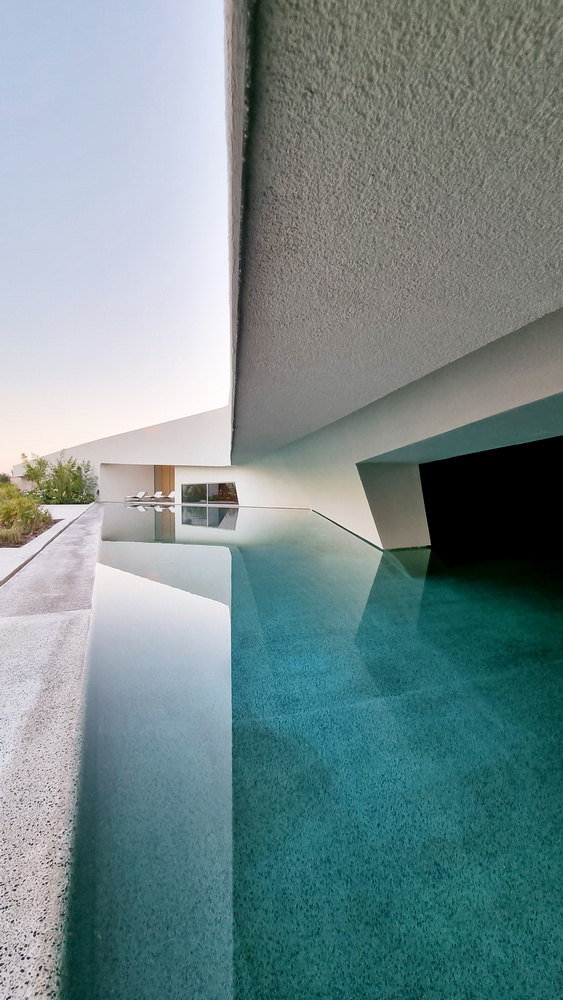
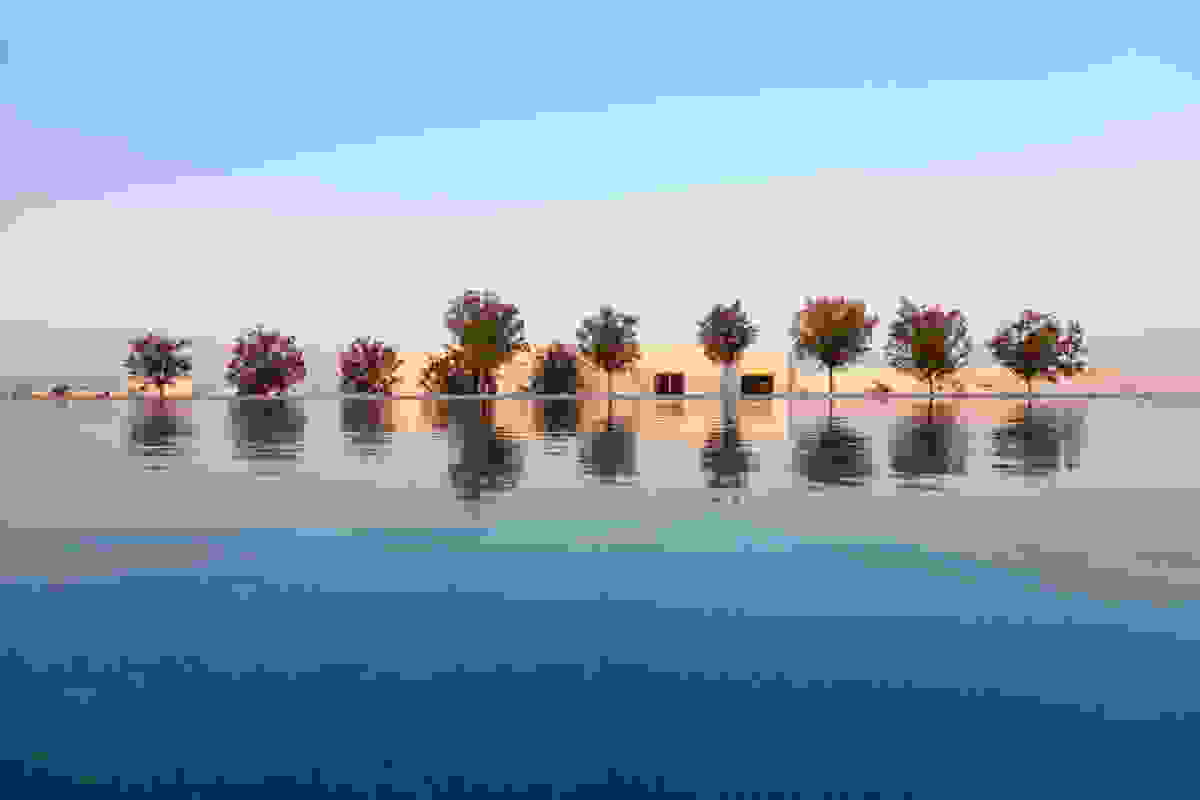
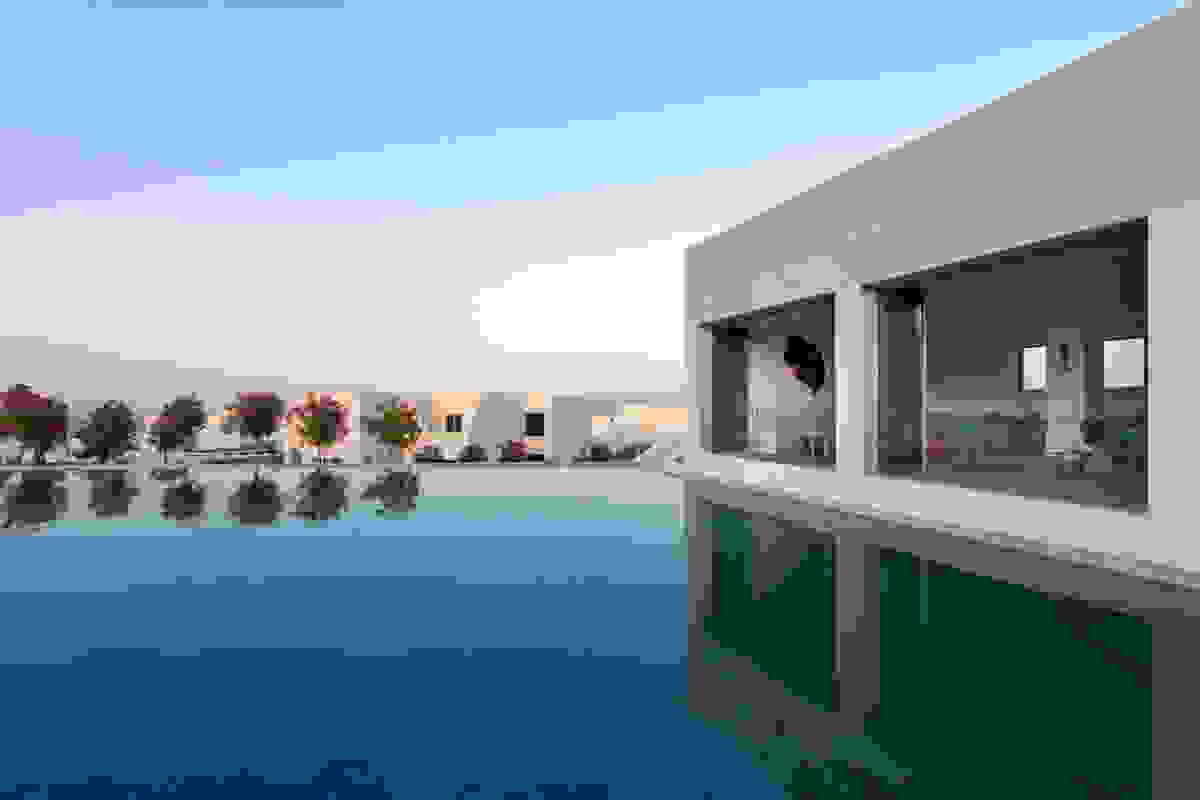
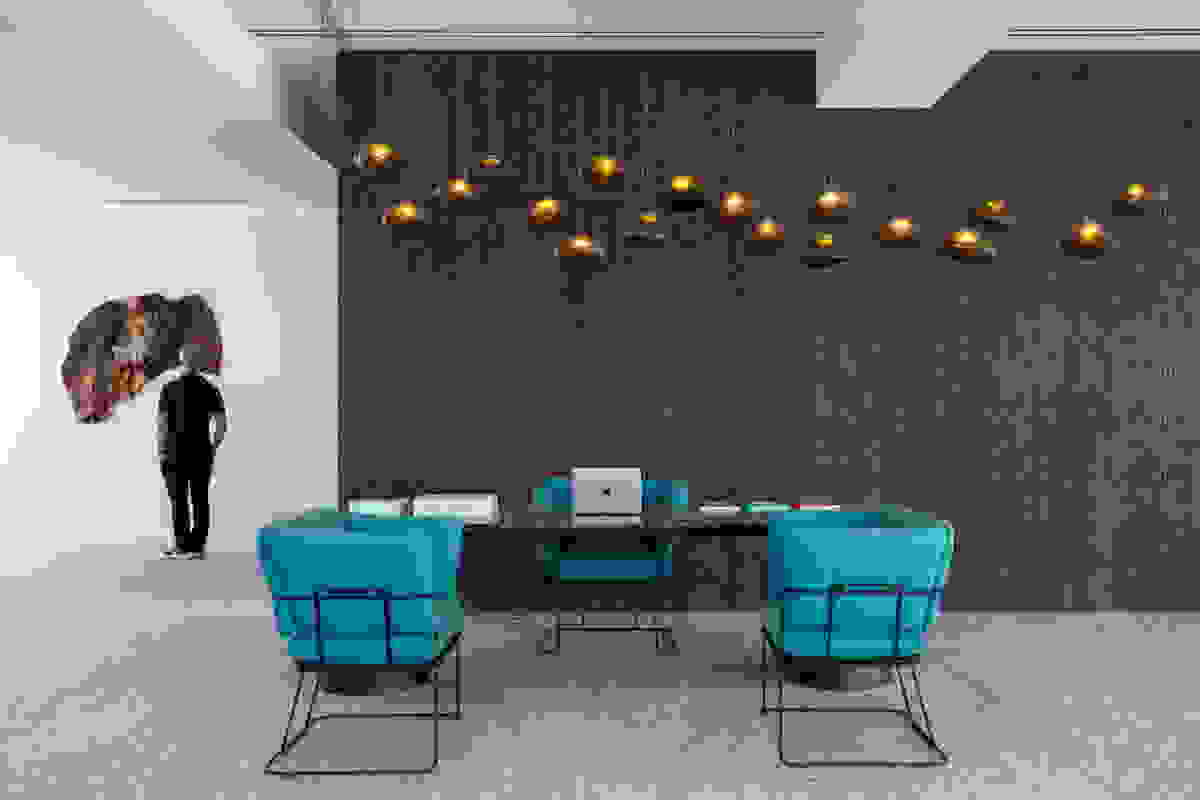
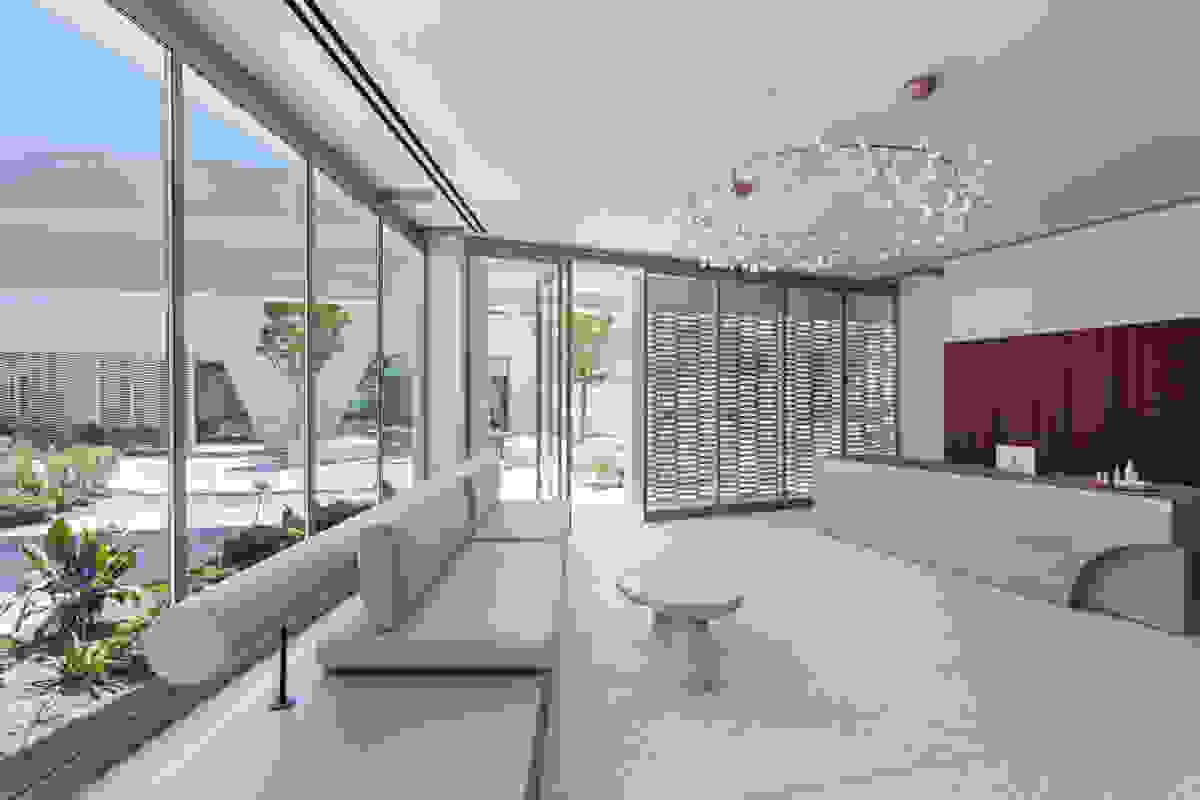
Arriving at the new reception, we are greeted behind the reception desk by a carved black wall. One could say in resemblance with the first image one has when approaching Santorini by boat: with the black rocks on the volcano and Nea Kameni. The reception opens up towards the central swimming pool, as the latter frames the view towards the sea and bends in the distance to the left -there, it forms a smooth, artificial beach towards the restaurant. Overhead, natural materials are selected: in the pool bar makuti covers the lower side of metal pergolas that take on organic shapes, while inside the restaurant the ceiling acquires illuminated wicker baskets. The presence of nature is also preserved in the bar on the upper floor in a large green wall as well as – on the terrace – in new metal pergolas that are frames for climbing frames. In the bar as well as in the central internal staircase leading to it, the extensive mosaic floors of the unit are combined with trapezoidal marbles, creating surfaces rich in color: the coexistence of these small and large-scale random materials simulate the fragmentation of materials in this volcanic island.
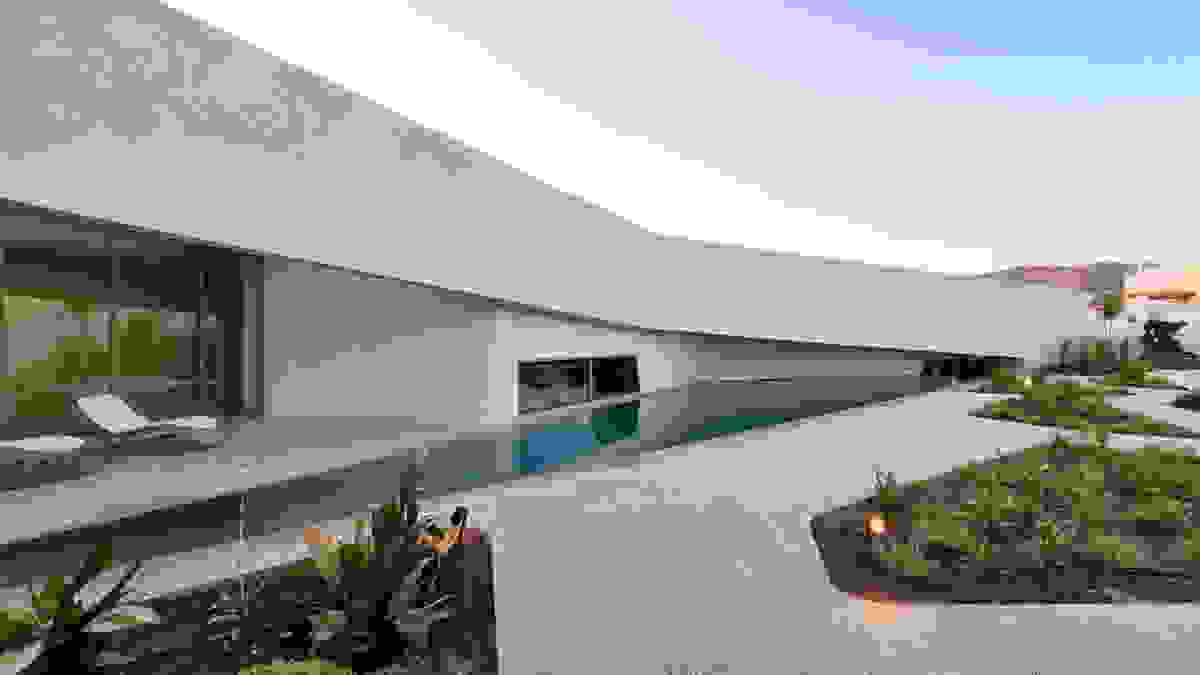
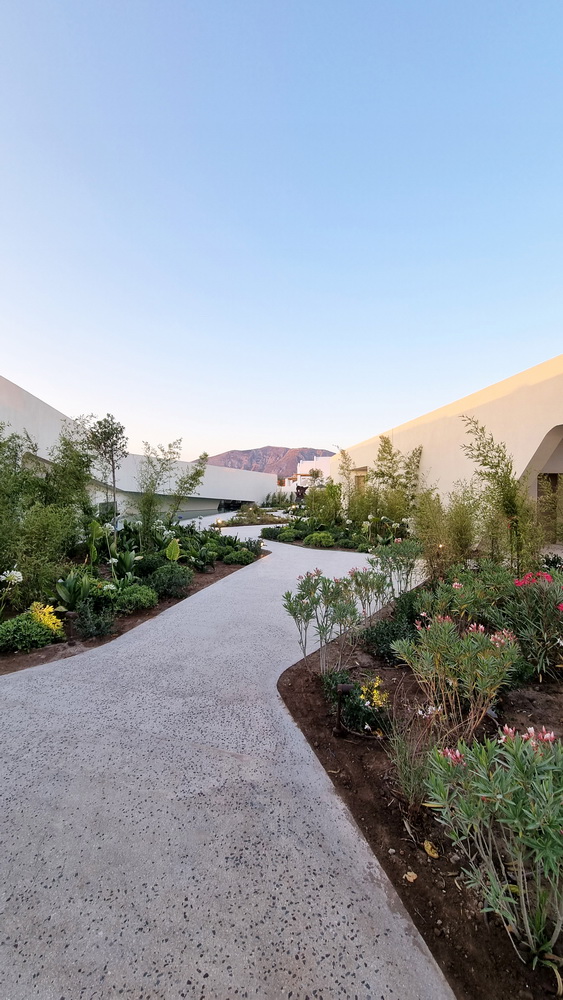
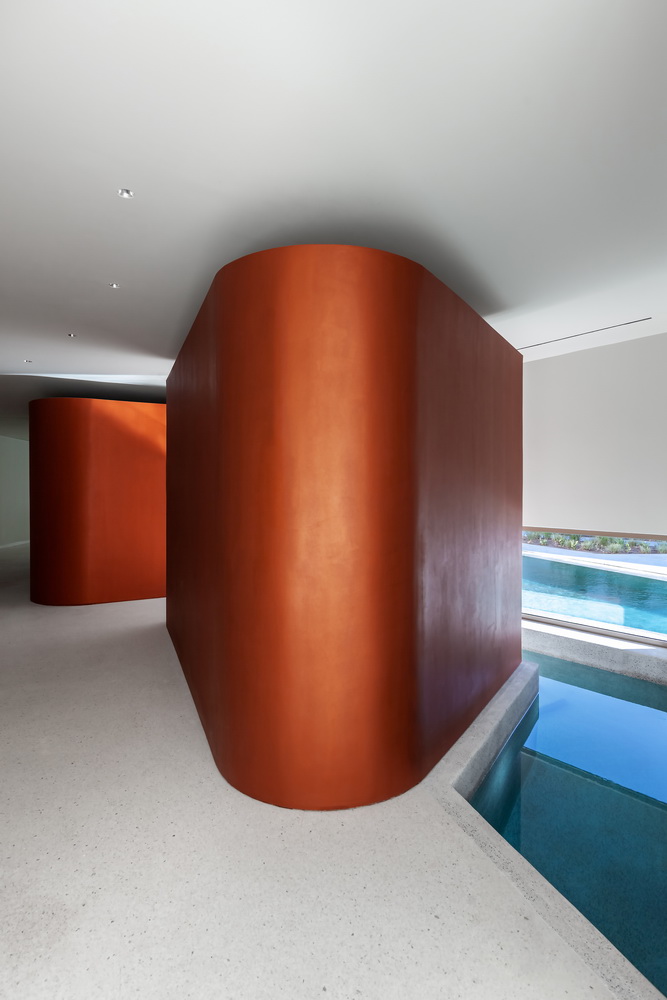
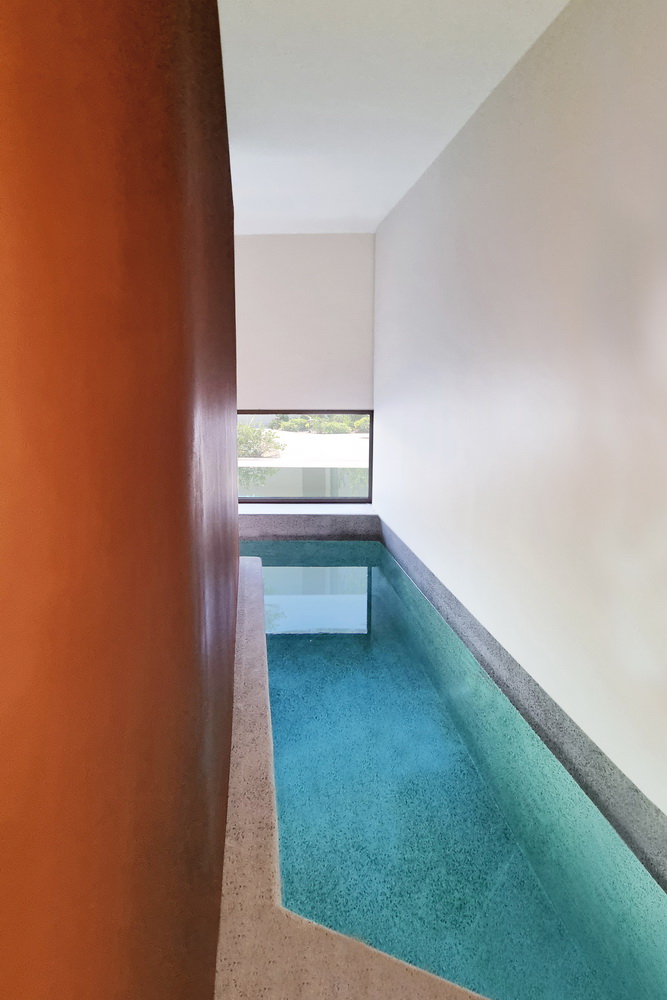
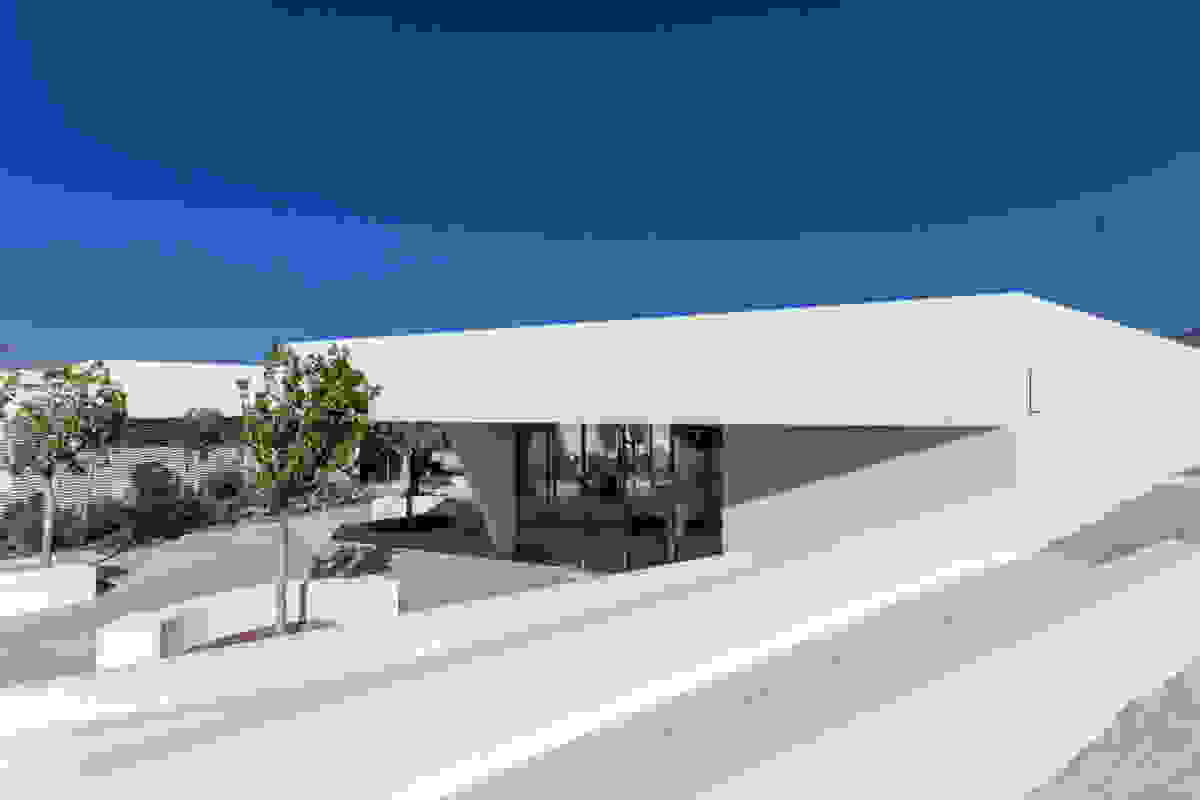
Lower on the property, the spa serves as a connecting element in the overall plot: placed centrally, it unfolds from the South part of the plot to the North part. Its inner sheltered courtyard of variegated planting is continued to the north by an expanse of oleanders below the central pool. In this way the carving of the landscape from the spa courtyard to the oleanders, unites new and old, the new suites with the renovation of the pre-existing Hotel, Santorini Image (1987-2010). The spa maintains a low profile so that escapes from neighboring suites remain unimpeded towards the East, towards the sea. The inner courtyard of the spa is suited to its function –instead of a large air-tight building, here you cross diagonally across the courtyard with its irregular planted areas: from the reception and changing rooms, across, to the gym, vitamin bar and treatment rooms. The west wing, due to the slope of the ground, is partially submerged in the ground. With this introverted typology, the spa simulates the natural ravines dug into the island’s volcanic pumice (called aspa), which characterize important settlements of the island such as Phoenikia and Vothonas (here the name itself means in Greek “large natural pit, ground subsidence”). It is this configuration of the natural terrain in the above settlements that leads to the construction of the characteristic cave dwellings on their sides. In the spa, white brick filters create porous boundaries and a play of light and shadow, a direct reference to one of the most successful architectural vocabularies of the modern reconstruction of Santorini after the 1956 earthquake, as it was then applied to the schools, banks and residences of the island.
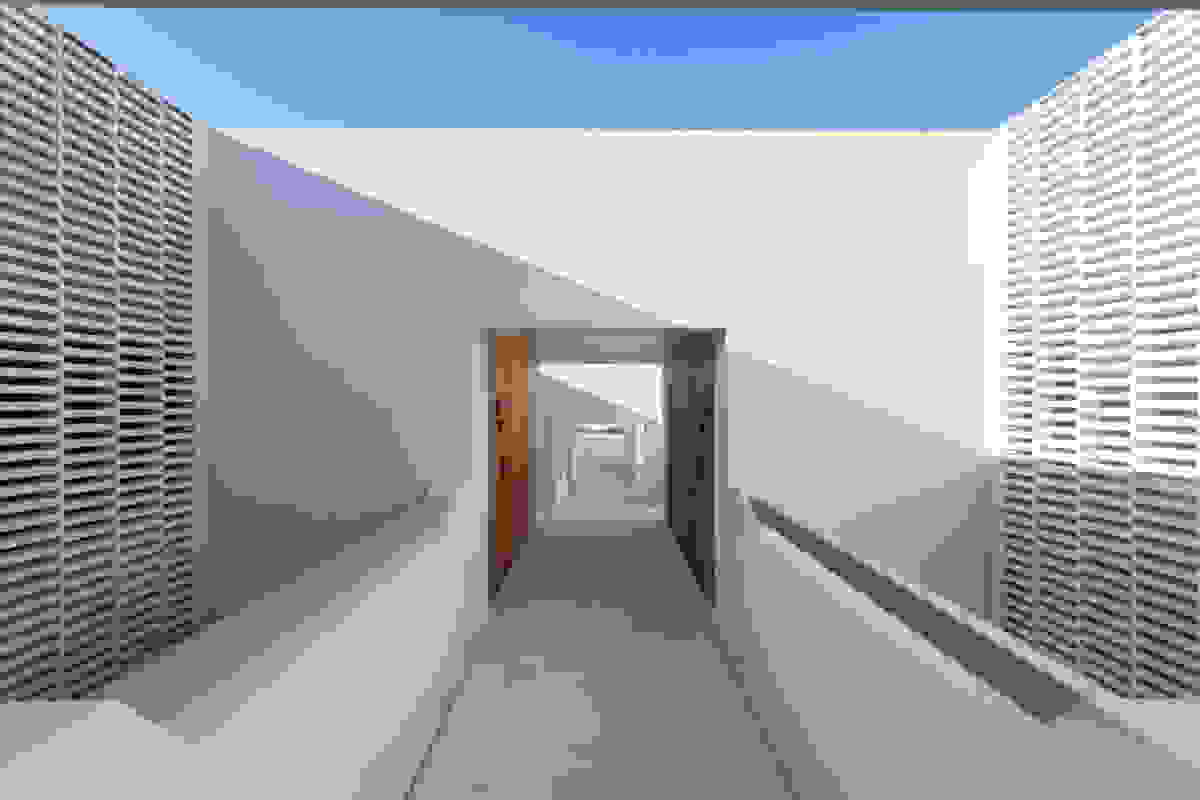
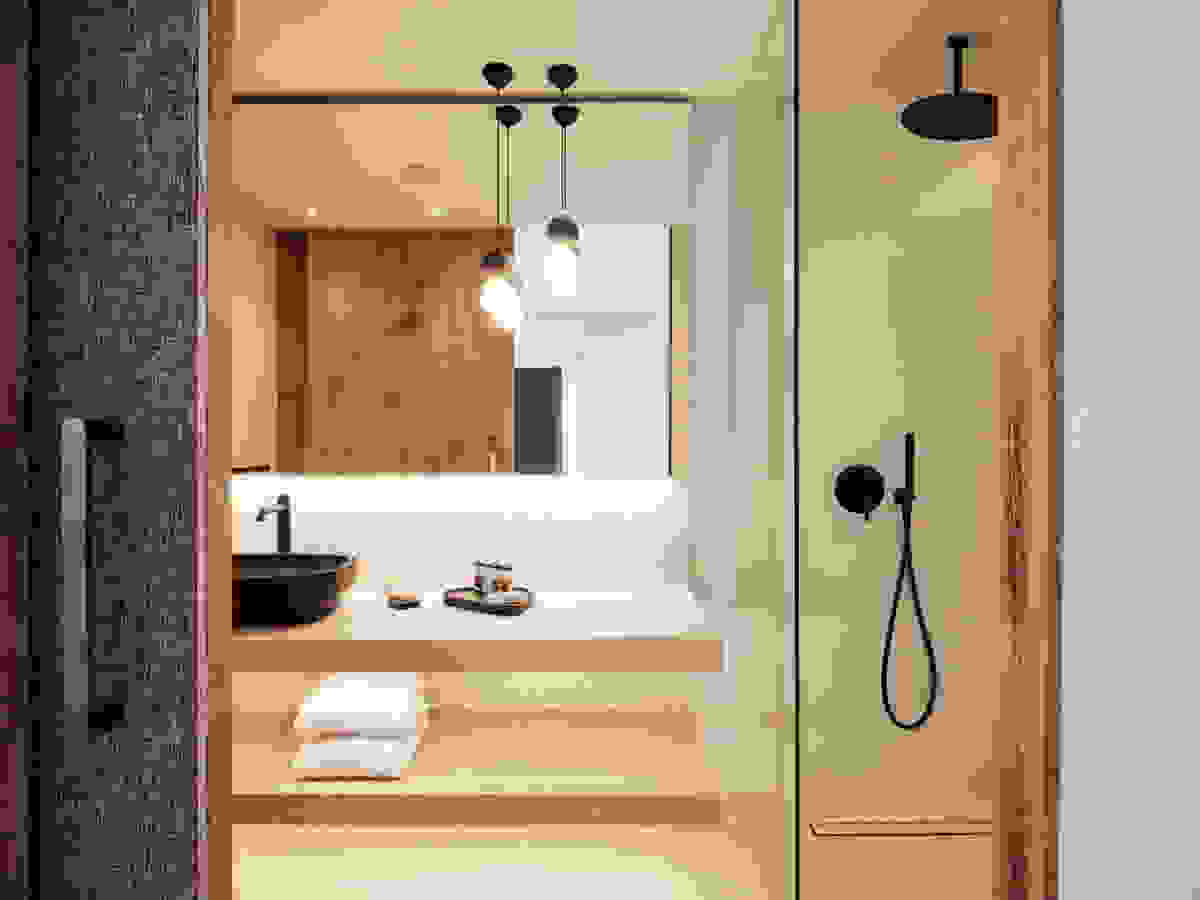
In the existing linear buildings of Noūs that flank the pool on the North and West sides, the renovation boldly replaced the central corridor with a completely new open-air route that offers a play of light and shade: In this way the arrival to the first floor rooms is made by a bridge which successively crosses seven courtyards with brick filters framing spacious bath rooms. In the creation of these rooms, the integration of conical recesses becomes a central theme, both in their new facades and in the interiors where, framed by tinted mirrors, they form modern “caves.” The rooms on the ground level have courtyards –makuti under the metal pergolas frames the fields around the unit and relates to them in texture and color.
The basic “icon” of Santorini’s architecture, the vault, was dominant in the pre-existing resort, Santorini Image, completed in 1987. And in fact, multiplied, it covered all buildings, regardless of proportions: From bungalows to the largest linear buildings, whether they housed rooms in a row or common areas. Realizing that the vault had ended up being scenography, we removed all vaults in our renovation, seeking alternative ways to connect to the island. In other words, it was understood from the beginning that the vaults “short-circuited” any attempt at architectural renovation. It was, after all, superfluous in terms of construction: Historically the vault had been extensively developed in Santorini in single-storey buildings due to the almost total lack of timber on the island –in combination with the strong mortars offered by aspa, it provided solutions that bridged openings without the use of wooden beams, also providing cooling (due to the height) in the hot climate of the island. Visible vaults were not used on the island for two-story buildings –all two-story buildings (as well as some single-story buildings) were built with vaults (or cross vaults) in the interior, hidden behind a flat roof. The reinstatement during the extensive reconstruction of the island of the two-story concrete visible vaults on the roofs no longer followed a constructional necessity but attempted a fictitious, falsified connection with traditional architecture.
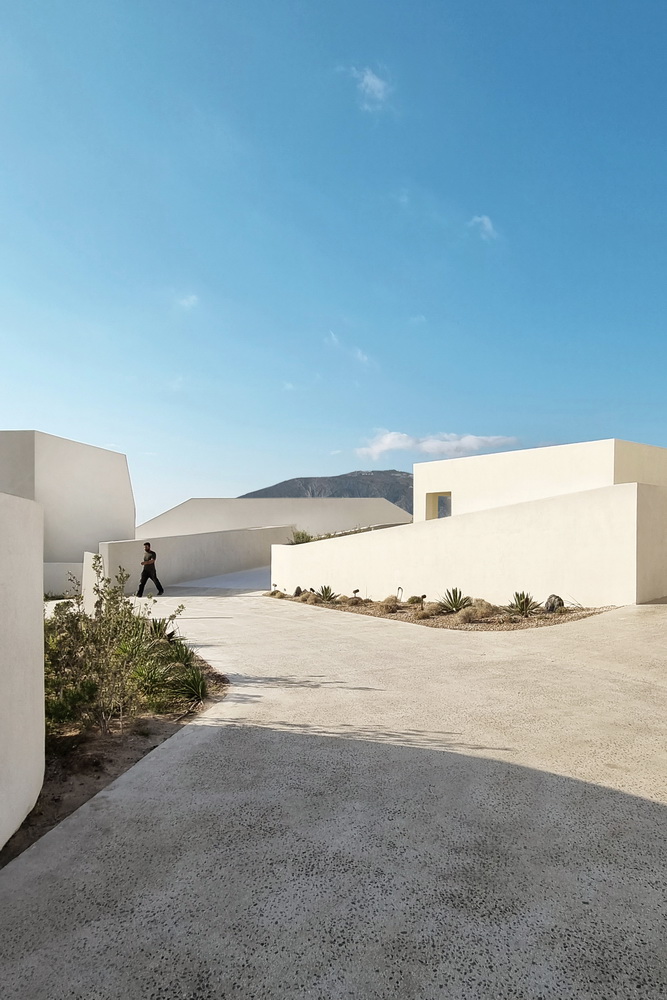
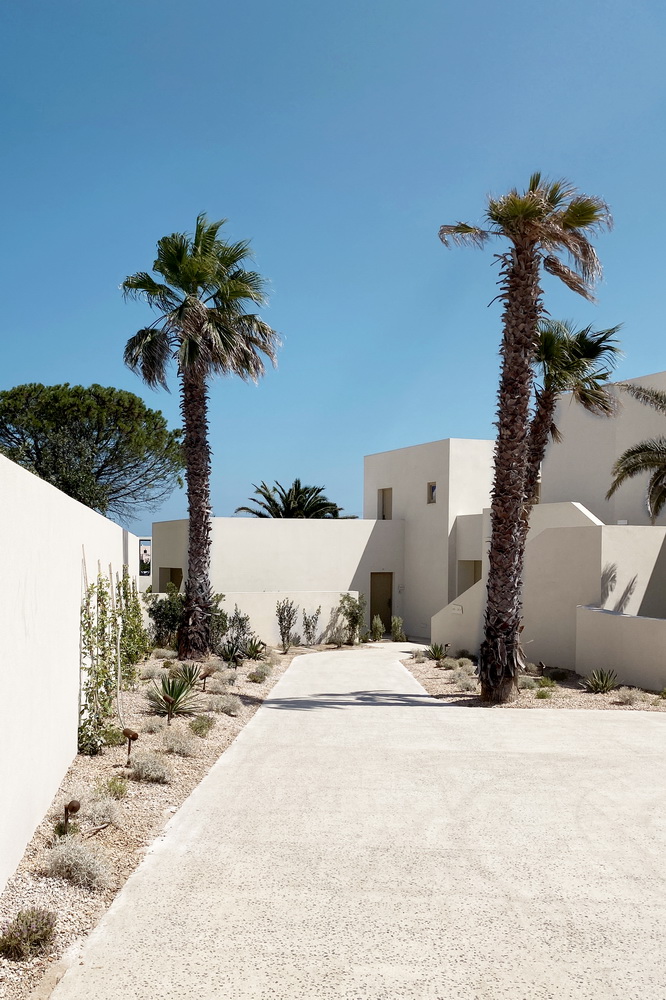
We attempted a corresponding revision in the organization of the landscape in the bungalow section. This was resolved in 1987 as if in a campus, where radial paths connected the buildings, like autonomous wings of a university. Among them a planting of conifers, lavender and shrubs which, like the extensive lawns around the old pool, were not associated with Santorini. Our research around the formation of this gently sloping landscape resulted in the formation of clusters/neighborhoods protected by curved walls: The movement between the bungalows is characterized by these soft curved walls that ascend and descend gradually. These fluid, organic contours continue the spa design and create enclosed private gardens instead of the prior “open” landscape.
We were inspired for this organic design by driving to Vlychada beach in Santorini: the car gradually descends towards the sea in an arid landscape where sand dunes of aspa form a road with continuous, gentle curves. A barren landscape with dry grasses and vines unfolds before you, a desert aesthetic. Many other beaches on the back side of the island have the same materiality, such as Baxedes further north, while the well-known stone terraces on the planted eastern slopes of the island preserve curved outlines. This arid relief landscape can also be found in Spain, in Bardenas Reales, in Navarre. Another important reference is Andreas Gursky’s two photos, Bahrain I and Bahrain II which are digital edits from the (equally deserted) Bahrain Formula 1 circuit (the edit adds additional laps to the existing track design). And without a doubt there are influences in the curved lines, especially in the spa from Zaha Hadid or from Enric Miralles – architects we looked at carefully, since their work refreshingly attempts this osmosis of landscape and building.
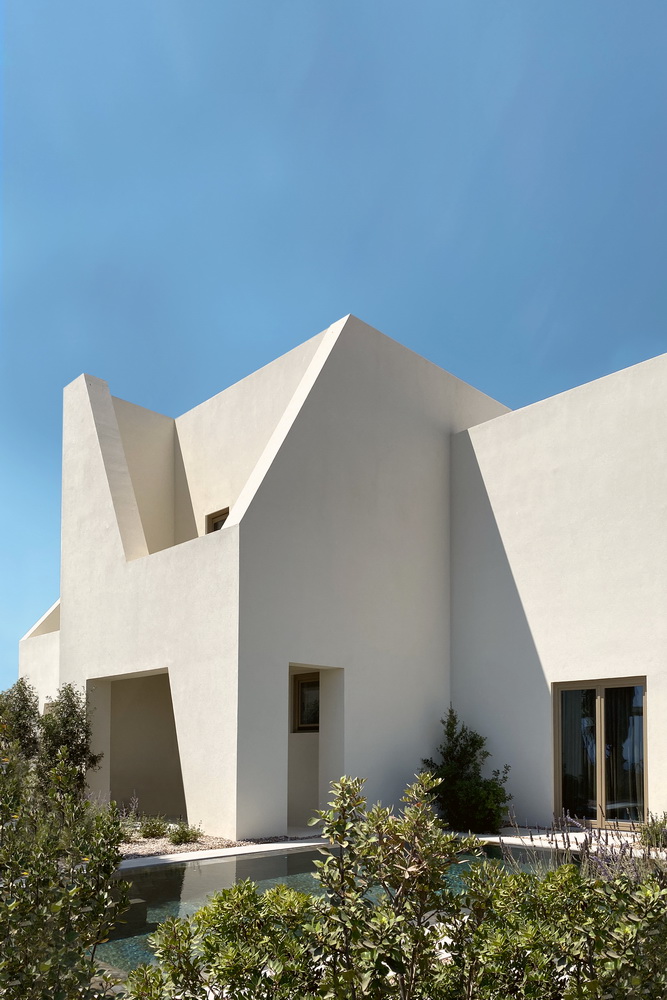
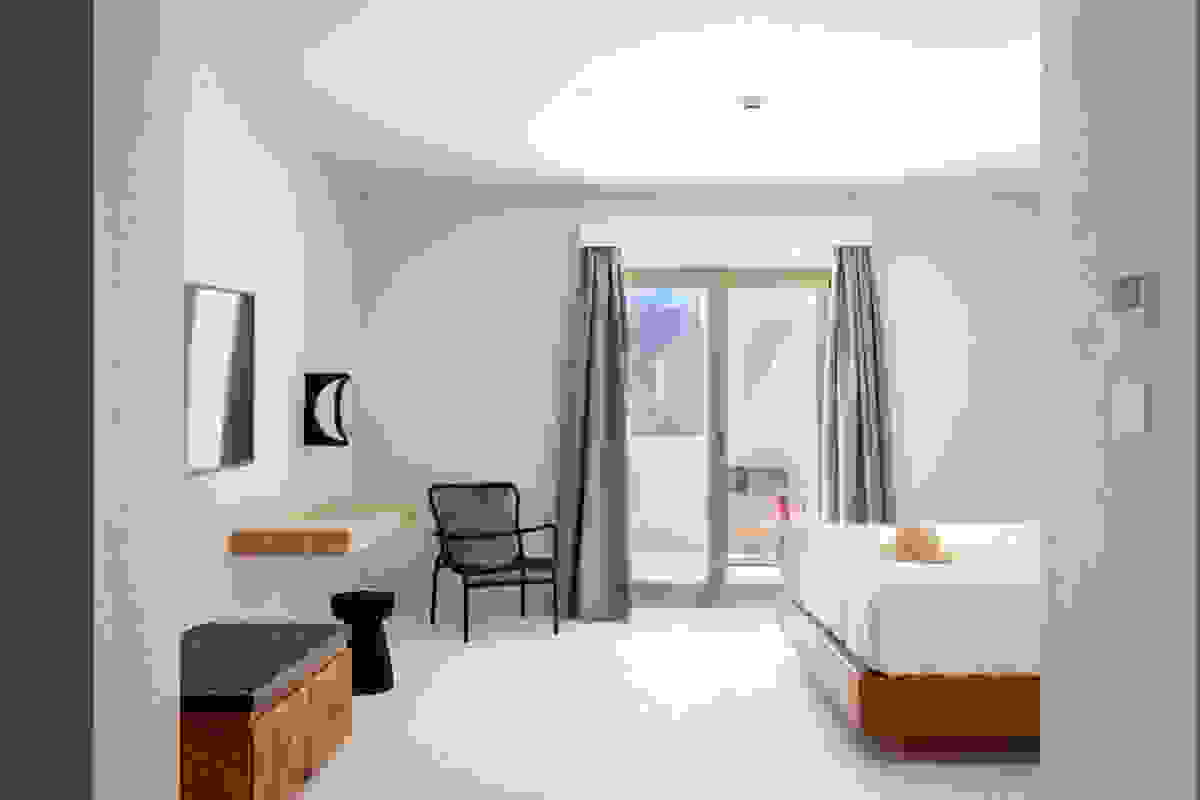
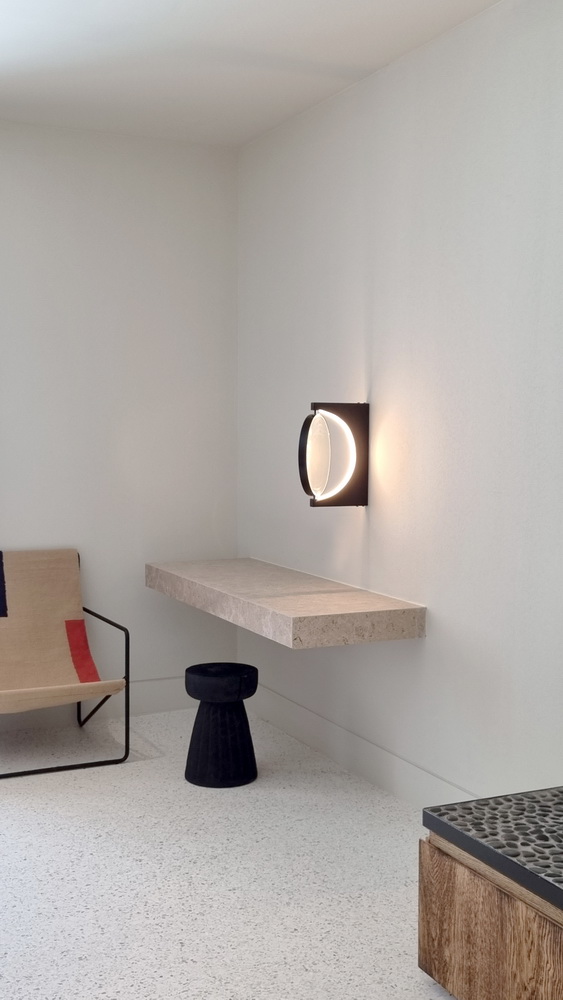
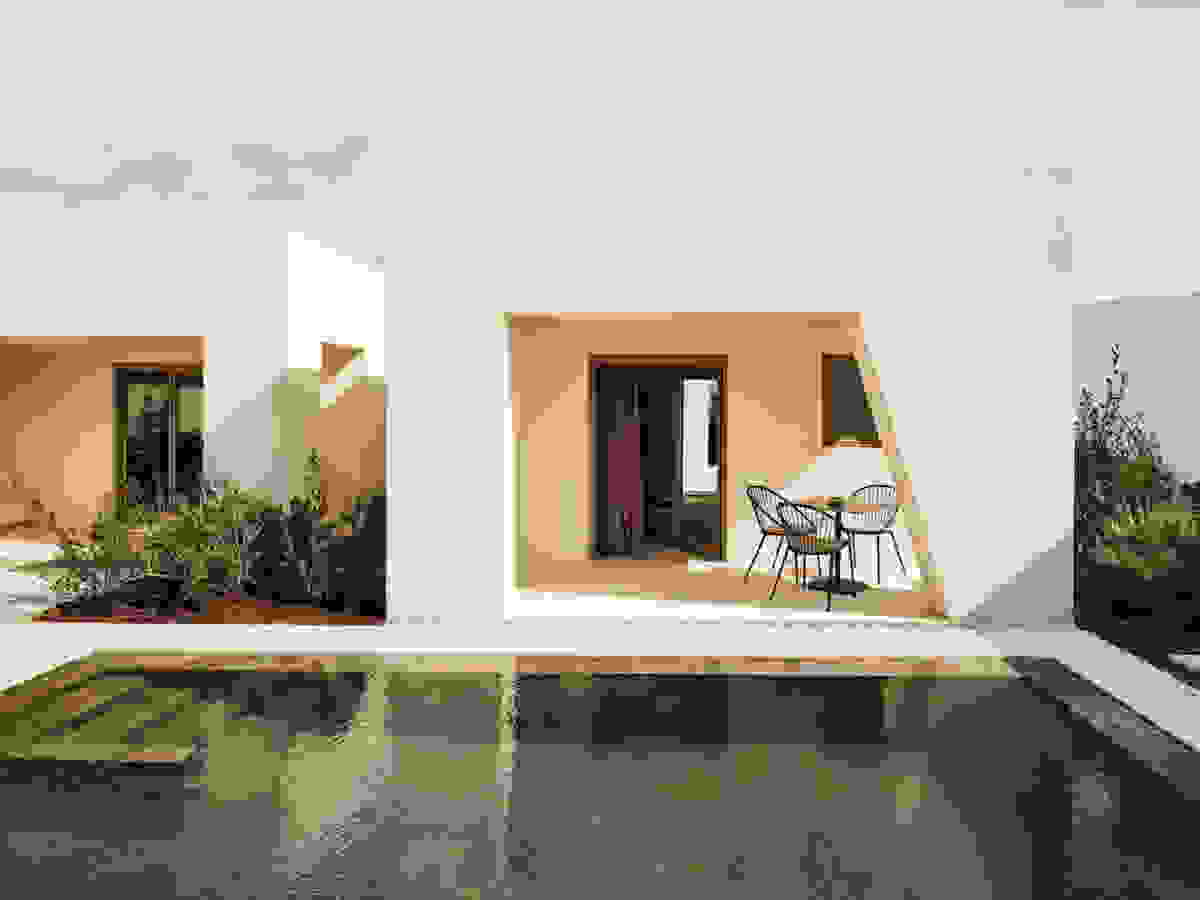
Looking for novelty, having removed the vaults in the bungalows, we shaped their facades with free walls that end in slanted sections, defining balconies on the first floor and semi-open spaces on the ground floor. This shaping of the facades gives variety to the whole, attempts a built simulation of the shadows falling from volume to volume and abstractly transforms the land drops in the steep Caldera that faces the volcano. This vocabulary on the walls is also shared with the new suites located east and west of the spa: in these rooms their walls extend towards the view and unfold intricately demarcating courtyards and pools. From above one can see the terraced contours of their roofs aligned towards the sea and the linear gardens that mediate offering privacy. In the rooms, we chose new mosaic surfaces, wood paneling with surface burnishing, lights made from volcanic rock and dividers with fabric linings, materials that make up a rich palette with references to earthy hues as they unfold in a kind of geological section during the island tour.