Back to Notes
1.

The Hammam and Sauna in Noūs Santorini testified our admiration for ceramics not only in their reddish warm color but also in their vessel-like shapes that, standing lower than the ceiling, form autonomous volumes.The same color is to be found in the Vitamin bar across the spa ravine.
3. Konstantinos Dekavallas led the team of architects Savvas Kontaratos, Vasilis Bogakos, Vasilis Grigoriadis, Nikos Sapountzis and Giorgos Zervas.

2.

another annotation!

Towards a Cycladic Modernism:
Noūs Santorini and the Mediterranean Wabi-Sabi

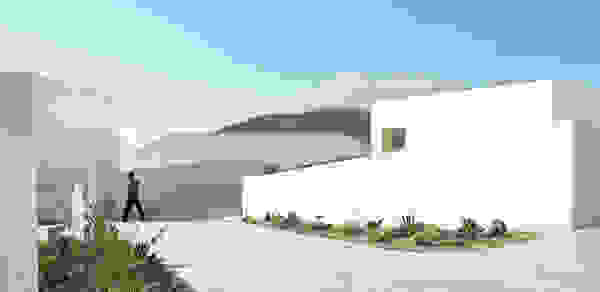
Τhe solid unwrapping facade of the spa in Noūs Santorini does not result from any rational procedure. It conveys the random and sculptural character of vernacular architecture in the Greek Islands, pointing towards a Cycladic Modernism. The lessons of traditional monolithic architecture with small windows are assimilated and reassembled here, after visiting Oia in Santorini systematically for 47 years. Our vernacular house there has a whitewashed double height facade split in two zones, both whitewashed: While the lower part is marked with two small windows and a (extra low) door, the upper part remains solid, a retaining wall for all the soil (aspa, the pumice of volcanic origin which constitutes all the upper soil layer in Santorini) that forms the roof. The two zones are almost aligned -the upper recedes only half a meter in relation to the lower zone1. The resulting house was subterranean and the ground overhead, by virtue of being painted, had become architecture, a “silent” facade just as significant as the lower “conventional” facade. Primary facade and secondary retaining wall perform distinct roles: the primary, lower elevation seems calm and rectilinear although it hides the vault that forms exclusively the interior of the house. The upper wall may accommodate the chimney (in some kind of sculptural twist) and at the same time lowers gradually, with a graceful curve, following the steep downhill inclination of Kaldera. This dialogue of primary and secondary, wall and ground, dominant solid and fortress-like openings, had opened up for us new possibilities: One could juxtapose large expanses of inarticulate solid walls in contrast to porous parts that dealt with everyday life -entrance, movement, exit, ventilation and light. This house had proven that architecture could, even at this domestic scale, retain a sculptural part, one unobstructed by windows, thus without scale. The house built without architects1 in Oia had managed to reach architectural luxury, the beauty of being blank, to have nothing to do, to mask all necessity.

Thus this critical bent in the facade of the spa at Noūs Santorini, becomes iconic: An architectural gesture unprovoked and unnecessary, it arrives with its superfluousness at something graceful, luxurious. It may remind us of the wandering promenades within Cycladic villages -this is even more pronounced by the landscaping within the spa ravine, a series of irregular planters that avoid straight lines. Further, one is tempted to say that this bent facade along with its gentle descent (the roof lowers towards the shallow water that connects indoors and outdoors) has something feminine. And the whole gesture to protect the first part of the spa with white, lace like, filters does not wander that far: On both sides of the spa ravine, brick filters offer privacy for the glass enclosed reception area, beauty salon and gym. The wall, decomposed2 and porous, reappears here, offering once again the contrast of extremes: floor to ceiling glass, veiled behind full height brick filters. Seek and hide becomes thematic not only in the facade treatment but also in the jagged corridor that leads from the reception area towards the -initially invisible– pool at the very end. In an unpredicted itinerary, one is to cross the beauty salon and the changing areas before reaching the sauna and hammam that are designed as mysterious ceramic vessels with no visible doors.2 Even later, the way water flows from the indoor pool to its outdoor part (a threshold moment so pivotal in Therme Vals by acclaimed Peter Zumthor), manages to crop all activity happening on the other side: We are witnessing clients walking in the ravine but we are only allowed to see their feet -their upper bodies, subjectivity itself, is invisible. The prioritization of blind surfaces that juxtapose one another is also retained in the numerous bungalows at Noūs: We managed to undermine all notions of columns and treat facades as solid cutouts slashed in diagonal shapes. In contrast to the spa building that was built from scratch, the bungalows were pre existing. In their renovation, in order to achieve facades that acquire a sense of independent movement –as walls stretched to various anchor points- we demolished many outer beams on the balconies of first floors and shifted them in recess, aligned with the rooms. The result is a complex dialogue where random diagonal walls seem to echo ephemeral cast shadows.

Clearly we are amidst a modernist architecture, one that seeks connection with Santorini’s celebrated modernist rescue plan in the late ‘50s, spearheaded by young talented architect Konstantinos Decavallas.3 It was dispatched and executed at an urban scale in 11 villages so as to alleviate the extensive damages of the disastrous 1956 earthquake. Our inspiration does not limit itself only to a shared iconography of white purist volumes -we have been looking also to the porous built filters they applied in banks, schools and houses. This reappraisal of Cycladic Modernism, one that favors emptiness, the sculptural and the picturesque, does not happen in a void. Because in recent years, without doubt, architecture in Cyclades has chosen its own mantra, one that finds recluse in the virtues of Wabi-Sabi. Scattered hats, baskets and exposed natural woods have all been summoned to instill the melancholy of a lost originality, one in which materials were untreated, patina celebrated, imperfection showcased.4 Rugged marbles, dark and cozy embellished interiors, linen spreads and woven textures are all being deployed to fend off the smoothness, blankness, sterilization of white modernist surfaces.5

Although one could trace some useful affinities with the Japanese sensibilities of hermetic Dimitris Pikionis, the style was imported from Berliner interior designers Lambs and Lions and Annabell Kutucu, while reaching canonical status in all recent Casa Cook resorts.6 Departing from small scale Greek archaic modesty, this newly formed Mediterranean Wabi-Sabi has been immensely popular for large scale developments, proving to be the much sought-after antidote to barren minimalistic interiors.7 Although the whole importation process had its own limitations,8 this was not just a discourse about the surface, streamlined vs rugged. It also reflected different attitudes about time: immaculate white volumes which would require constant maintenance to retain their intrinsic aura of newness9 vs a slow architecture with weathered materials that register time and celebrate patina.10 Noūs Santorini goes against the grain in that respect: With its white pristine looks, it feels more comfortable within a graphic or illustration vocabulary where bold geometric shapes dominate.11 However, stepping out of this magic ravine at the Noūs Spa, one realizes that both Cycladic Modernism and Mediterranean Wabi-Sabi need the superfluous, an excess beyond the merely functional, so as to lead to the sculptural (in the first case) or to decorative details within a warm earthy paradise (in the second one).

Memos Filippidis, August 2022